Maybe medieval people happened upon a T-Rex fossil and came to a relatively logical conclusion that dragons existed.
I’ve read a couple books on this actually, thats exactly what happened. Also cyclops are from looking at bones from a certain type of baby elephant. The giant note hole and tiny eyes made it look like a single eye.
Yep, can confirm! And what’s even funnier to me is that back in the dark ages, Greek people used to find a lot of prehistoric bear skeletons – and those look exactly like human skeletons, except they’re like eight feet tall or something – so they naturally assumed those were the heroes of legend, and made armour and clothes for them and reburied them with the most splendid and sacred religious ceremonies they could think of? Fast forward five centuries, Athens’ all modern and rational, philosophers and scientists aren’t taking any shit from anyone – but the problem is, people will randomly find graves containing giant-ass warriors, so that’s something that can’t be explained away and yeah, demigods were a thing and yeah, they used to be eight feet tall and sorry I don’t make the rules.
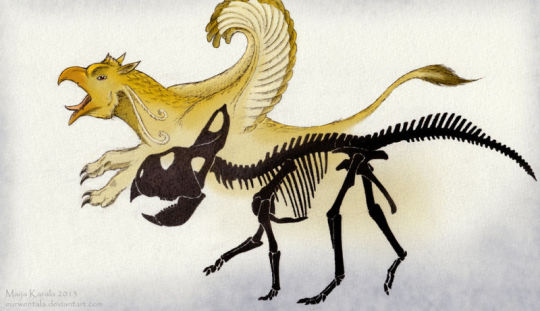
Ancient people had no idea what the bones of ancient creatures would look like or a concept of extinction. So strange bones that looked unlike modern animals were imagined based on their similarity to modern animals. A beaked dinosaur was imagined to have the head of an eagle, it’s clawed feet looked like a lion. So many mythological creatures are an assortment of different animal features, head like an X, body like a y. This may be from finding fossils which didn’t resemble any one modern animal but sort of resembled different features from various sorts of animals.
One of the most useful things I’ve learned about recovering from trauma is that my decisions need to be judged according to the incomplete information that was available to me at the time.
So, say I’m deciding whether to eat chicken at a restaurant. All evidence is that it’s a good idea. I’m hungry for chicken, and I usually feel good after eating it.
I eat the chicken, and I get food poisoning. The resulting illness causes me to fall short of responsibilities, and creates numerous problems for me and the people who depend on me.
What happened?
Trauma brain says: “This happened because I am Bad At Making Decisions. If I had made The Right Decision and not eaten chicken, everything would have been fine.”
Recovery brain says, “According to the information that was available to me, the chicken was unlikely to make me sick. Eating chicken was a Good Decision with Bad Consequences. This happened to me because I had incomplete information.”
The “trauma brain” response makes all decisions really hard, because each decision involves the prospect of being judged by a future self that has more information.
“Should I buy the $2 mouse pad or the $3 mouse pad? If I buy the cheaper one and it doesn’t work well, it will be my own fault for not buying a better quality one…”
(Then I might end up paying myself $1-per-hour to agonize over which mouse pad to buy, which is probably an ACTUAL unwise course of action.)
But if I foster the “recovery brain” response, I can start to trust that my future self will judge my decisions kindly.
“If I buy the cheap mouse pad and it doesn’t work, then I only gambled $2 on it. If I buy the $3 one and even it doesn’t work, then I’ll have more closely guessed how much I need to pay for a mousepad of sufficient quality.”
And then later when the mousepad doesn’t work: “Well, that didn’t work. At least I made a decision. The outcome has given me more information about the options available to me going forward.”
(Meta level: Decisions you made prior to reading this post about how to treat yourself were probably good given the information you had access to about trauma and recovery!)
tl;dr: Bad results are not always evidence of bad decisions. Give yourself the benefit of the doubt about why you do what you do.
Wait, you mean those are trauma responses? That’s not normal? Not everyone freezes up in complete error mode for 8 months because they can’t possibly spend 25 euros on a bag because it’s a luxury (my old one is too heavy for me to carry w my disability, but it’s not entirely broken either so I can’t. Justify. The. New. Bag.)
This is .. not normal?
Well, speaking as someone who also has a lot of chronic illnesses, it could be a trauma response or an “I’m not used to being this disabled” response. An abled person could reasonably shop around at thrift shops for a cheaper bag, and an abled person wouldn’t need to pay as much attention to their body’s needs.
getting new health problems means learning to make decisions based on an ever-shifting set of criteria (as I am learning on a daily basis). It’s super reasonable to freeze sometimes under those circumstances.
it is also a trauma response. it could totally be trauma.
Tbh I think that money ones specifically are often conditioning based on poverty (often also trauma because struggling to survive is traumatic!) And pretty much anyone I know who is poor beats themselves up over that stuff.


 Urocyon's Jaunts 2.0
You must be logged in to post a comment.