hey guess what everyone, it’s time for a new installment of Weird Biology! yaaay! (CLAP NOW.)
this week’s animal might look like a children’s edutainment mascot, but it’s an avian death machine with built-in machine-gun sound effects. really.
so hold onto your butts folks, because it’s time to meet-
gesundheit! haha! please do not bite me!
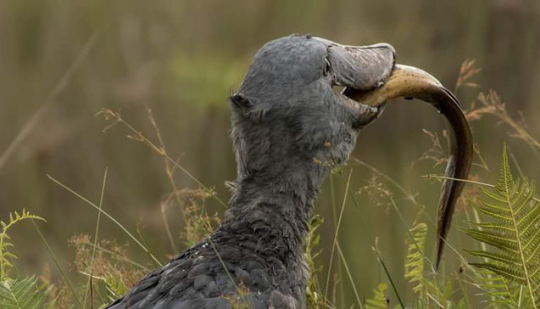
the Shoebill is a stupidly huge modern dinosaur with a ginormous beak, which kind of looks like… uh, a shoe. (BLESS YOU)
the Shoebill (BLESS… fine, fine I’ll stop) has several different names in other languages. the best one by far the Arabic Abu Markub,which can be translated as“Father of a Slipper”.
obviously this name is way, way better than anything I could ever come up with in a million years, and I should just quit my job and stop the article right here.
I won’t, though. you still have to read like another six paragraphs of this. suffer.
the Shoebill is a gigantic bastard of a bird, reaching up to five feet tall and fifteen pounds heavy. they’re simply too much bird to handle, especially when you consider that enormous clog of a beak. that odd bill may look like a cute dutch shoe, but the edges are razor-sharp and built to decapitate prey with a single heavy blow.
the Shoebill is what you would get if you were to take a Velociraptor and tape a fucking axe to its face, which kind of ruins the friendly muppet look they’ve got going on.
(that and the death glare.)
HEY KIDS! let’s have a staring contest! Timmy why are you crying
the Shoebill is found in tropical East African swamps and wetlands. they stalk around in the reeds and generally skulk around like most cranes and herons do, but with a couple of important differences. (yes, those differences are all scary. hang on.)
first, Shoebills are hunting for larger prey than your typical heron or crane. and while they do usually go after fish and eels up to 3 feet long (!!!), the Shoebill is a criminal of opportunity. they will eat anything, from baby crocodiles to smaller waterfowl to baby antelopes. BABY. FUCKING. ANTELOPES.
so maybe don’t trust them around your children, is what I’m getting at here.
HEY KIDS! who wants to see if I can fit this ENTIRE DUCK in my mouth? TIMMY, YOU’RE NEXT.
second, Shoebills are very, very, veryveryvery patient. they stand next to the water and just. don’t. move. you’d think the Shoebill was trying to win a staring contest with the river, but I can assure you that it’s nothing that innocent. the Shoebill is waiting.
once an edible-looking fish/eel/nile monitor/baby antelope swims by, the Shoebill strikes. five feet of hungry bird slams beak-first into its potential meal, swinging it around a few times like a Jurassic Park Velociraptor (to get the mud off. mud is gross even to Shoebills), and snipping the head clean off with that terrible beak. oh, and then the Shoebill swallows it whole. headfirst. (it would be if the prey still had a head attached, anyway.)
AAAAAAAAAA. AAAAAAAAA!
awful table manners aside, Shoebills actually do manage to scrounge up some compassion in their black black hearts when it comes to their children.
*paper rustles* wait. hang on, I read that wrong. ahaha, whoops! they don’t, actually.
at the end of the rainy season, two Shoebills will court by making machine-gun sound effects with their beaks at each other. (really) once they have decided they can stand each other long enough to make some beautiful babies together (Shoebills are notoriously antisocial), the pair wander off to a distant corner of the swamp, where they will build a fuckoff huge nest and lay up to three eggs. awww!
however, only one of those eggs is going to make it to adulthood.
take a quick break to stare at something adorable.
this is by design. the strongest chick will become a strong adult. “wait… how do they know who’s the strongest?” you ask tremulously, an unnamable fear in your eyes. you are correct to be wary! the answer is siblicide.
that’s right, the strongest chick will straight-up murder its weaker siblings by shoving them out of the nest to drown/be eaten by crocodiles. and the parents just kind of watch. jesus.
I mean, I GUESS that’s as good a way as any to make sure at least one chick is strong enough to make it, but man.
don’t trust these guys around your children, that’s all I’m saying.
HEY KIDS, it’s time for TODDLER DEATHMATCH! may the strongest offspring prevail!
despite their many nightmarish qualities, Shoebills remain an iconic bird and a valuable part of the ecosystem (why, without them we’d be knee deep in baby antelopes). they have appeared in human art and culture from the Ancient Egyptians to The Audobon Society.
they’re pretty neat.
Shoebills are also currently considered Vulnerable, with their habitat under threat from human encroachment. we really, really, really hope that this giant murderbird continues to thrive in the future, mostly so that if the day ever comes when someone points up into the air and cries “Look! A Shoebill!” we can all turn around in unison and scream,
“GESUNDHEIT!”
–
thanks for reading! you can find the rest of the Weird Biology series here.
if you enjoy my work, maybe buy me a coffee to support Weird Biology.
–
IMAGE SOURCES
1-Birder’s Blog 2-Zambia Tourism 3-Reddit 4-The Telegraph 5-Africa Geographic 6-Zooborns 7-Ranger Diaries 8-Know Your Meme
Photo Credits: Honeychild Coleman (Photo by Ed Marshall Photography NYC), Kathy Foster (Not sure, but if this is yours please let me know!), Shingai Shoniwa (Photo by BEN STANSALL/AFP/Getty Images), Tracy Wormworth (Not sure, but if this is yours please let me know!
———-
This is the last part of a four part series exploring Black Women who are in punk bands. Last but not least to be featured are the following talented ladies.
Honeychild Coleman (top left): From Kentucky, Honeychild Coleman’s influence has extended across various well-known bands, including “The Slits, Greg Tate’s Burnt Sugar Arkestra , Mad Professor, Apollo Heights , Death Comet Crew (with Rammellzee), Gregor Asche AKA DJ Olive and Raz Mesinai’s Badawi” (1). Besides being a solo artist, she also plays guitar. Her music was featured in the groundbreaking film Pariah. Suggested Song:Echelon (Live) (Website – Facebook – Twitter)
Kathy Foster (top right): Kathy Foster is best known as the bassist for punk band The Thermals, and plays drums for All Girl Summer Fun Band as well. She is original from California, but moved to Portland, Oregan around 1998. Suggested Song:A Pillar of Salt (Live) (Kathy Foster Wikipedia)
Shingai Shoniwa (bottom left): Shingai Shoniwa is associated with post-punk band the Noisettes, where she plays bass and provides leading vocals. According to Wikipedia, her first name means “be bold/courageous/strong” in the Shona language, which is a Bantu language native to the Shona people of Zimbabwe. Shingai met future Noisettes bandmate Dan Smith at the BRIT School for Performing Arts & Technology (located in Croydon), which she attended. The Noisettes have reached critical acclaim, having been praised by Rolling Stone, the New Yorker, and others. Suggested Song:Never Forget You (Live) (Wikipedia – Instagram)
Tracy Wormworth (bottom right): Tracy Wormworth comes from a family of musicians – her brother Jimmy Wormworth is a drummer for The Conan O’Brien show, and her father and sister are also musicians (a jazz drummer and vocalist, respectively). Tracy herself plays bass guitar, currently as a member of the B-52s, but originally as a member of new wave band The Waitresses. She has toured with many well-known acts besides the B-52s, including Cyndi Lauper, Sting, and Phyllis Hyman amongst many others. Suggested Song:I Know What Boys Like (Wikipedia)
———-
If you missed the other parts of the Punk series, they are here: Part 1 – Part 2 – Part 3
Humans had enough trouble seeing other humans as human. We are not even remotely smart enough to know how smart animals are. We would have a huge existential crisis if we realised other creatures are as sentient and aware as we are.
Its also important to recognise that this is not just human ignorance, we all have a vested interest in pretending animal intelligence cannot ever compare to ours. How intelligent an animal is when compared to humans shouldn’t even matter, but it turns out it is much easier to exploit and kill animals if we pretend they are mindless automaton.
This is all true, and important, BUT animals deserve bodily autonomy regardless of their intelligence. Intelligence is not a marker of worth. To suggest otherwise is ableist.
You don’t have to understand asexuality or aromanticism (or bisexuality, pansexuality, being trans, noninary etc.) Just acknowledge it, respect it, and move on. These are real live human people we’re talking about here, just be nice.
If nearly a decade interviewing the wealth managers for the 1% taught me anything, it is that the ultra-rich and the ultra-poor have a lot more in common than stereotypes might lead you to believe.
In conversation, wealth managers kept coming back to the flamboyant vices of their clients. It was quite unexpected, in the course of discussing tax avoidance, to hear professional service providers say things like:
“I’ve told my colleagues: ‘If I ever become like some of our clients, shoot me.’ Because they are really immoral people – too much time on their hands, and all the money means they have no limits. I was actually told by one client not to bring my wife on a trip to Monaco unless I wanted to see her get hit on by 10 guys. The local sport, he said, was picking up other men’s wives.”
The clients of this Geneva-based wealth manager also “believe that they are descended from the pharaohs, and that they were destined to inherit the earth”.
If a poor person voiced such beliefs, he or she might well be institutionalized; for those who work with the wealthy, however, such “eccentricities” are all in a day’s work. Indeed, an underappreciated irony of accelerating economic inequality has been the way it has exposed behaviors among the ultra-rich that mirror the supposed “pathologies” of the ultra-poor.
In fact, one of the London-based wealth managers I interviewed said that a willingness to accept with equanimity behavior that would be considered outrageous in others was an informal job requirement. Clients, he said, specifically chose wealth managers not just on technical competence, but on their ability to remain unscandalized by the private lives of the ultra-rich: “They [the clients] have to pick someone they want to know everything about them: about Mother’s lesbian affairs, Brother’s drug addiction, the spurned lovers bursting into the room.” Many of these clients are not employed and live off family largesse, but no one calls them lazy.
As Lane and Harburg put it in the libretto of the musical Finian’s Rainbow:
When a rich man doesn’t want to work
He’s a bon vivant, yes, he’s a bon vivant
But when a poor man doesn’t want to work
He’s a loafer, he’s a lounger
He’s a lazy good for nothing, he’s a jerk
When the wealthy are revealed to be drug addicts, philanderers, or work-shy, the response is – at most – a frisson of tabloid-level curiosity, followed by a collective shrug.
Behaviors indulged in the rich are not just condemned in the poor, but used as a justification to punish them, denying them access to resources that keep them alive, such as healthcare and food assistance. Discussion of poverty has become almost impossible without moral outrage directed at lazy “welfare queens”, “crackheads” and other drug addicts, and the “promiscuous poor” (a phrase that has cropped up again and again in discussions of public benefits over more than a century).
These disparate perceptions aren’t just evidence of hypocrisy; they are literally a matter of life and death. In the US, the widespread belief that the poor are simply lazy has led many states to impose work requirements on aid recipients –even those who have been medically classified as disabled. Limiting aid programs in this way has been shown to shorten recipients’ lives: rather than the intended consequence of pushing recipients into paid employment, the restrictions have simply left them without access to medical care or a sufficient food supply. Thus, in one of the richest counties in America, a boy living in poverty died of a toothache; there were no protests, and nothing changed.
Meanwhile, the “billionaire” in the White House starts his days at 11am – the rest of the morning is coyly termed “executive time” – and is known for his frequent holidays. “Nice work if you can get it,” quipped an opinion piece in the Washington Post.
We don’t hear much about laziness, drug addiction or promiscuity among the wealthiest members of society because – unlike Trump – most billionaires are not public figures and go to great lengths to seek privacy. Thus the motto of one London-based wealth management firm: “I want to be invisible.” This company, like many other service providers to the ultra-rich, specializes in preserving secrecy for clients. The wealthy people I studied not only had wealth managers but often dedicated staff members who killed negative stories about them in the media and kept their names off the Forbes “rich list”.
Many even present themselves as homeless – for tax purposes – despite owning multiple residences. For the ultra-rich, having no fixed residence provides major legal and financial advantages; this is exemplified by the case of the wealthy businessman who acquired eight different nationalities in order to avoid taxes on his fortune, and by the UK native I interviewed in his Dubai apartment building:
“I am not tax resident anywhere. The tax man says ‘show me a utility bill’, and the only utility bill I can present is for the house I own in Thailand, and it’s in a language that the European authorities aren’t familiar with. With all the mobility going on in the world, international marriages, governments can’t keep up with people.”
Meanwhile, the poor can end up being “resident nowhere” because no one will allow them to stay in one place for very long; as the sociologist Cristobal Young has shown, the majority of migrants are poor people. In addition, the poor are routinely evicted from housing on the slightest pretext, frequently driving them into homeless shelters – which are in turn forced to move when local homeowners engage in nimby (not in my back yard) protests. Even the design of public spaces is increasingly organized to deny the poor a place to alight, however temporarily.
It is as if the right to move around, to take up space, and to direct your own life as you see fit have become luxury goods, available to those who can pay instead of being human rights. For the rich, deviance from social norms is nearly consequence-free, to the point where outright criminality is tolerated: witness the collective shrug that greeted revelations of massive intergenerational tax fraud in the Trump family.
For the poor, however, even the most minor deviance from others’ expectations – like buying ice cream or soft drinks with food stamps – results in stigmatization, limits on their autonomy, and deprivation of basic human needs. This makes life far more nasty, brutish and short for those on the lowest rungs of the socio-economic ladder, creating a chasm of more than 20 years in life expectancy between rich and poor. This appears to some as a fully justified consequence of “personal responsibility” – the poor deserve to die because of their moral failings.
So while the behavior of the ultra-rich gets an ever-widening scope of social leeway, the lives of the poor are foreshortened in every sense. Once upon a time, they were urged to eat cake; now the cake earns them a public scolding.




 Urocyon's Jaunts 2.0
You must be logged in to post a comment.