Durham Attorney Scott Holmes Challenges N.C. Court Fees as Unconstitutional

dr-archeville:

A group including the ACLU of North Carolina and the Southern Coalition for Social Justice is challenging the constitutionality of court fees being levied in North Carolina.

Durham attorney Scott Holmes filed a constitutional challenge to the court costs statute today in Wake Court Superior Court, saying the state constitution requires such fees to go to public schools.  Instead, he says, the revenue is funding the court system. 

“This is an important step in reversing the flow of resources in the school-to-prison pipeline.  Our Constitution requires that the fees collected in criminal cases shall fund the education of our children in public schools, not fund our courts,“ Holmes said in a statement.

His motion centers on the case of two demonstrators arrested during a 2016 Moral Monday protest at the state legislative building.  Carol Anderson and Dale Herman were convicted of trespassing and have appealed their cases.

According to the motion, since 1995, the minimum court fee for district court has risen from $41 to $178 and in superior court from $48 to $205.  There are other costs too, for being in jail, for being under pretrial release supervision, for failing to appear in court, for expert testimony, and for a court-appointed attorney (to name a few).  Some of the money goes toward technology, upkeep of judicial facilities, and retirement and training for law enforcement.  Holmes says these fees are punitive and, under Article IX, Section 7 of the state constitution, the money must go to public schools.

Holmes goes on to say that the General Assembly in recent years has passed “a number of statutes which impose almost insuperable obstacles for any judge who wants to waive or reduce costs and fees for a criminal defendant.“  Most recently, a new law took effect on December 1 requiring judges to give fifteen days’ notice to state and local agencies before waiving fees for those who can’t pay. 

“All of this raises serious questions about the fairness of our criminal justice system and about its promise of justice for all.  It also suggests that our criminal justice system fails to comport with basic constitutional norms, including the guarantee of equal protection, due process, the prohibition against excessive fines, and the right to counsel,” Holmes said.

“We must do everything we can to end the unconstitutional practice of funding our court system on the backs of the poor and indigent people of the state,” said David Hall, criminal justice attorney at the Southern Coalition for Social Justice.  “The burdens of court fines and fees disproportionately affect people of color, and it’s time to end this practice.”

The ACLU of North Carolina is encouraging other attorneys to file motions challenging the constitutionality of court fees.

“For far too long the legislature has gotten away with circumventing the state constitution to fund an array of state agencies on the backs of the poor,” said Cristina Becker, criminal justice debt fellow at the ACLU of North Carolina, which is part of the coalition behind the motion.  “North Carolina’s excessive court costs have created modern-day debtors’ prisons that keep people in jail simply for being poor and have a devastating impact on communities across the state.”

Read the motion here: Court Cost Motion by Sarah on Scribd

Durham Attorney Scott Holmes Challenges N.C. Court Fees as Unconstitutional
It’s another of those days where I need to wake up in just over 2 hours now (oops) because I’m expecting a package.

At least this is with a courier that notifies you of a 1-hour time slot, so I just need to check e-mail instead of getting up to wait for them. Can hopefully reset the alarm and go back to sleep after that.

ETA: Having a working doorbell again makes deliveries less anxiety producing too. As I had hoped. Better plug the second receiver in the bedroom too, just to be safe.

New paint colors invented by neural network

birdblogwhichisforbirds:

lewisandquark:

So if you’ve ever picked out paint, you know that every infinitesimally different shade of blue, beige, and gray has its own descriptive, attractive name. Tuscan sunrise, blushing pear, Tradewind, etc… There are in fact people who invent these names for a living. But given that the human eye can see millions of distinct colors, sooner or later we’re going to run out of good names. Can AI help?

For this experiment, I gave the neural network a list of about 7,700 Sherwin-Williams paint colors along with their RGB values. (RGB = red, green, and blue color values) Could the neural network learn to invent new paint colors and give them attractive names?

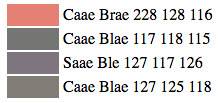
One way I have of checking on the neural network’s progress during training is to ask it to produce some output using the lowest-creativity setting. Then the neural network plays it safe, and we can get an idea of what it has learned for sure.

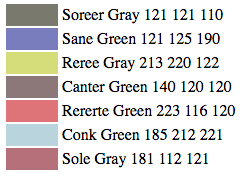
By the first checkpoint, the neural network has learned to produce valid RGB values – these are colors, all right, and you could technically paint your walls with them. It’s a little farther behind the curve on the names, although it does seem to be attempting a combination of the colors brown, blue, and gray.

By the second checkpoint, the neural network can properly spell green and gray. It doesn’t seem to actually know what color they are, however.

Let’s check in with what the more-creative setting is producing.

…oh, okay.

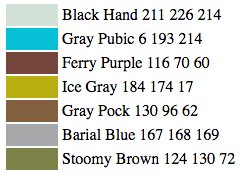
Later in the training process, the neural network is about as well-trained as it’s going to be (perhaps with different parameters, it could have done a bit better – a lot of neural network training involves choosing the right training parameters). By this point, it’s able to figure out some of the basic colors, like white, red, and grey:

Although not reliably.

In fact, looking at the neural network’s output as a whole, it is evident that:

  1. The neural network really likes brown, beige, and grey.
  2. The neural network has really really bad ideas for paint names.

@nostalgebraist

fullyarticulatedgoldskeleton:

“Learn to respect disabled people’s privacy” is especially relevant because people go to extreme lengths to violate our privacy just because they think talking about a disability in public/using things that are for disabled people publicly are incriminating enough on their own to warrant it. An entire class of people should not be considered criminal by default. Nobody has a right to your detailed medical history, what kind of medications you use, how your body works, what sex is like for you, what you spend your money on, whether or not you’re on benefits, or any other kind of personal information.

fullyarticulatedgoldskeleton:

You know, I keep getting asks about my diagnosis, generally within the framing of “I want to know so I can see if I have the same thing.”

There was a time when I had my diagnosis in my About. I took it down because, after years of trying to make it fit, I realized it didn’t anymore. The only aspect of my previous diagnosis that made sense to me was “avolition.” Most doctors I talked to hadn’t even heard of it, and those who had argued that I couldn’t possibly have it because I was “too coherent,” without bothering to investigate further.

I kept telling people over and over again that I have trouble making a connection between a thought and an action and that this happened whether or not I was depressed, and nobody investigated further.

I spent over a decade clinging to a diagnosis that only sort of made sense because “avolition” was the best word I could find for the inability to initiate tasks that had nothing to do with depression.

I have not been getting the help I need because I kept getting misdiagnosed over and over and over again. I have been dangling at the edge of a cliff by my fingers where the only thing between me and losing everything I’ve worked for in life is the kindness of friends. I have gone to doctors faithfully and tried medications and tried therapy and applied for SSI over and over again and here I am today with zero help relevant to my disability. I have been forced to beg for donations just to keep myself where I’m at, but never to improve my life or go forward. It’s like the past five years of my life has just been waiting. Waiting for the doctors to help. Waiting for a caseworker to call back. Waiting for my SSI application to go through, waiting for a response. Waiting, waiting, waiting to get help that might not ever come.

I don’t go out much. I don’t get to see people. I don’t go to the park, or the library, or the local fair. I sit in my apartment and I try to entertain myself as best as I can. Mostly I’m okay. I’m used to being alone and I’m used to occupying my time with books and the internet. But it’s extremely boring and extremely limiting. There are things I want to do with my life. There are places I want to see and people I want to meet. But I can’t go, because I’m waiting. I don’t have the money or the transportation to go anywhere.

What this is all building up to is that I don’t actually give a fuck about diagnostic labels. If it’s possible for the professionals in my life to consistently miss, over and over again, that I’m disabled, whether or not I have the proper diagnosis, whether or not I have words for what’s going on with me, then why should I care whether my brain fits into this box or another? I kept telling people “this is what I think is going on with me” and they’d say “no, because the label on your box says something different” and then they would never suggest re-diagnosis. I have had a doctor outright give up on trying to treat me and say she was “stumped” without referring me to anyone else, rather than think, “Hey, maybe this diagnosis is no right for you?”

Because professionals have consistently, and for years, been wrong about me I have been forced to sit completely still in life. I have been forced to endure isolation and boredom.

What has helped me, instead, has been communities full of disabled people talking about their experiences. I’ve found things in common with people across all sorts of diagnostic labels, when psychiatrists would tell me that’s not possible, because brains belong in boxes and the boxes never ever touch. But I’ve found things in common with people who have depression, or autism, or ADD, or even chronic illness. I’ve learned new things about myself through knowing other disabled people, and I’ve learned coping strategies my doctors have never even heard of, and more importantly I’ve learned to have hope for the future, because I know now that being a happy disabled person is an option (as opposed to either my life will always suck or the right treatment will make me abled).

I’m not going to be able to offer anyone a diagnosis by telling them mine. Instead I’m going to point to the things that helped me. There are a lot of reasons a person could have trouble in school. Learning or developmental disabilities. Executive dysfunction, concentration problems, autistic inertia, avolition. Sometimes prompting helps, sometimes breaking things down into tasks helps, sometimes visualization exercises help, setting alarms, and so on.

I’m also chewing over the idea that maybe I won’t ever put my diagnosis in my About again. Not because it’s a secret- I’m not ashamed of it, I’m not afraid of what strangers will say about it, and I discuss it regularly on my blog. But because I want to encourage people to respect disabled people’s privacy. Even if you’re disabled, yourself, “what’s your diagnosis?” isn’t all that different from “well what’s wrong with you, then?” I don’t feel like disabled people should have to automatically disclose in order to talk about disability. I talk about the way my disability works and how it affects my life, and those things are not unique to my diagnosis. Like I said, there are people across many diagnostic labels who share those things in common with me. Sorry, but I can’t diagnose you over the internet, even if my story really resonates with you. I encourage you to check out a variety of bloggers who talk about ADD, autism, executive dysfunction, inertia, or avolition, though.

Democrat Doug Jones has won the special election to fill a Senate seat in Alabama, according to exit polls and returns – a shocking upset in a solidly Republican state, in which massive turnout among African American voters helped defeat a candidate enthusiastically backed by President Trump. The Associated Press called the race at 10:23 p.m. Eastern time. Jones becomes the first Democrat elected to the Senate from Alabama since 1992. The Senate seat came open when Trump chose former Sen. Jeff Sessions (R-Ala.) to become attorney general earlier this year. Jones’s victory followed a pattern set earlier this year in Virginia’s gubernatorial election: a wave of enthusiasm among the Democratic party’s traditional base, which was aided by a swing from Republicans to Democrats among well-educated suburban voters. Jones, 63, is a former U.S. attorney best known for prosecuting two Ku Klux Klan members for the 1963 bombing of a Birmingham Baptist church, which killed four girls. The bombers were not tried until the 1990s.

thatstupidgirlshow:

So, I’m really embarrassed but I’m also really desperate and I woke up to my water being shut off.

We owe $100 to Detroit Water and Sewerage, and I tried to pay as much as I could on a previously $300+ bill. I paid 240, and my mom and sister aren’t able to help because they don’t have the funds or hours at work. I’m a tarot diviner and I can do a three card spread for $2 and any card spread of your choice for $5. I’m a writer, even though I don’t do much of it here, I’ve been published, and I’ll proofread/edit fic & original works for $6 a page. I don’t know what else I can do, and I feel awful for even asking, but we can’t go without water.

I’ve been drowning in bills since I moved back home to help out, if you can help, please please please, do. If you can’t, please spread this around, I would really appreciate it.

$willidoit

PayPal: paypal.me/dibbledobb