As a 69-year-old lesbian, I am concerned about how your film will portray old lesbians. I am especially concerned about how your own ageism is apparently shaping the film and how it will reinforce attitudes which the lesbian and feminist communities are trying to change.
[… You write:]
We are very excited about the potential of this film to raise public awareness about the unique problems and concerns of older gays.
Surely you know that these “unique problems” are the problems of every gay in this country. If you ask a 30-year-old lesbian whether she’s concerned, when she enters a hospital, that her lover can be denied visitation rights, she’ll say, “Damn right, I am.” She might even tell you an experience in which she or her lover had been refused such rights. […] And do you believe that, across the country, in rural areas and in many cities, young lesbians are not today facing the loss of a lover with nobody to tell about it? It is dishonest, ageist and exploitative to have these battles and forms of oppression projected as unique to old lesbians — to have the battles fought on the turf of the old.
It is especially exploitative because old women are already seen as powerless and pathetic. We are already seen, ad nauseam, as the embodiment of younger people’s fear and shame around sickness, need, physical weakness, death, and loss of loved ones — as if these were our principal attributes, and as if they were unique to us. Must we continue to be portrayed as powerless and pathetic because that is how younger lesbians choose to see us? Or because it serves the purposes of younger lesbians?
Instead of selecting out old lesbians and gay men to ask how we feel about our “unique problems” around hospitals, wills, loss of loved ones, how about asking us, “How do you feel about being patronized by younger people, gay or straight?” If SAGE [then Senior Action in a Gay Environment] is to be used as a model for services across the country, if they are to advise film-makers about the lives of old lesbians, they need to start asking such questions. Or better yet, asking themselves, “How would I feel?”
SAGE circulates a reprint of a newspaper description of their services […] regarding their young volunteers:
One such volunteer is Liza, a young lesbian in her 20s who visits an infirm 80-year-old lesbian who has been confined to a hospital. “She is an important part of my life,” Liza said of her older friend. “She has so much knowledge, experience, and wisdom — she’s like a treasure. She’s like my own collected history — it’s like seeing pictures from the 1920s.”
This kind of sentimentalizing and fossilizing of old women is so offensive that when I think of this woman being subjected to it I am appalled. I am compelled to try to get the entire lesbian community to wake up to our own ageism and stop this exploitation of old women. Stop it and stop it now.
I am confirmed in my fears about the film by your title, The Silent Pioneers. We are all pioneers; why are old lesbians the “silent” ones? Why project closetedness onto us as if — again — it were our unique problem? […] “Silent” is not the adjective that sums up my life to me or to the lives of the lesbians I have known.
The world has not seen many images of old lesbians, and I insist that your film portray us as the real, strong women we are. […] With the framework you’ve publicized for The Silent Pioneers, how will you set up interviews that elicit power rather than victimization? Will old lesbians in your film be able to say, “I chose not to marry, I chose not to raise children for the male state, and I am sick and tired of being thought of as a grandmother, by straight and lesbian young people alike!”? If not, I’d rather see the strong straight old women from OWL, the Older Women’s League, saying, “We’re fed up with how we are treated,” than be objectified by my lesbian sisters of SAGE.
— Barbara Macdonald, writing to Pat Snyder about her planned film Gay Seniors: The Silent Pioneers, on which SAGE consulted, in “A Call for an End to Ageism in Lesbian and Gay Services,” in Lesbian Ethics, Vol. 1, No. 1 (1984), ed. Jeanette Silveira. Italics in original; bold mine.
(first tiger jumps in) *laughing* Vanya, what is this? Van’ … Van’, get out of the boot, Van’. (second tiger approaches) Mishka … let’s go. Mish, let’s go. Mishka! Mish, let’s go. Come on, sit. Sit. (third tiger comes in) Bonya, you too are here! Ok let’s go guys. Let’s go! *starts singing* x
Just Russian Things
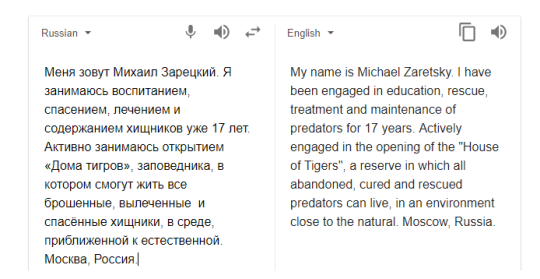
Big cat stuff can often be sketchy even if the content looks cute, so I clicked on the source for the video and this guy apparently runs a sanctuary for rescue tigers and other big cats near Moscow. His YouTube bio is in Russian, but here’s what it says according to Google Translate:
So you can feel happy knowing that these big dumb cats are loved and being looked after.
Oh man, you have you idea how relieved I am to see that followup. I thought this was some crazy oligarch or something…
Listen here, bub, Smilin Sid Hatfield did *not* get shot to death by company gun thugs on the steps of the Matawan courthouse just so your boot-lickin self could vote away the Social Security what that I pay good fuckin money into every fuckin week. Fuck your red hat and fuck your coal mine and fuck your flag and fuck your statues and most of all fuck you.
Well, I had my dates mixed up; Sidney Hatfield was actually murdered in McDowell County, not in Matewan.
So the Battle of Matewan was an incident that happened on May 19th, 1920 in Matewan, West Virginia, considered to mark the beginning of the West Virginia Coal War. The United Mine Workers of America had been trying to organize in West Virginia but faced considerable resistance from the mining companies, who hired a private security firm–the Baldwen-Felts Detective Agency–to harass and threaten union miners. The miners hated the Baldwen-Felts agents, whom they called “company gun thugs,” and the sympathetic mayor of Matewan appointed a union miner named Sidney Hatfield as chief of police in an effort to control them. Sidney was called “Smilin Sid” because he was also a blacksmith, and had repaired his own broken teeth with gold caps (!!!) which he was extremely proud of; the appointment came as a surprise to the more “respectable” citizens because, in addition to having literally no experience with law enforcement, Sid Hatfield also had a reputation for starting (and winning!) fights with anti-union miners. He looked like this:
So in the spring of 1920, the Stone Mountain Coal Corporation evicted all of the union miners from company housing, so the miners and their families moved into a shantytown on nearby abandoned land. In May, a gang of Baldwin-Felts enforcers armed with Thompson sub-machine guns came to drive the miners out of their tents as well, but were waylaid at the train station by Hatfield and a group of deputized miners. This led to an awkward situation where Sid Hatfield, as chief of police, served an arrest warrant on Albert Felts, and Albert Felts, who’d been deputized by the constable of Magnolia, served an arrest warrant on Hatfield. The two belligerent parties moved to the porch of the Chambers Hardware Store to await word from a judge, with the mayor acting as mediator. When the judge declared that Sid’s warrant was legal while Albert’s was bogus, Albert responded by drawing a gun and shooting the mayor, which led to a gunfight that tragically cost the lives of three miners and wonderfully cost the lives of thirteen gun thugs including Albert and Lee Felts themselves. This has gone down in history as the Battle of Matewan, the beginning of the West Virginia Coal War.
Sid and his friend Edward Chambers were charged with murder for the incident, but were acquitted on grounds of self-defense and defense of others on August 1st, 1921. As the two men, unarmed and accompanied by their wives, walked down the courthouse steps following their acquittal, a group of Baldwin-Felts gun thugs rushed out of the crowd and opened fire on them, killing them.
Sidney Hatfield and Edward Chambers were seen as martyrs for miners’ rights against corporate greed and tyranny, and their legend helped to greatly speed up the UMWA’s organizing push.
I did not know this. I knew unionizing was tough, but being bombed by your own government…
Oh man, the Coal War is just one story out of very, very many. The history of workers’ rights in this country is written in blood; it’s been the default position of the United States government and its autonomous wings to respond to labor organizing with violence, whether that’s strike-breaking, police brutality, outright murder, or, yes, bombs. So when you’re taking your lunch break or enjoying a weekend, don’t forget that people literally died for those things.
I was going to list some specific incidents, like the Ludlow Massacre, the Harlan County War, the Pullman strikes, the Brookside Strike, Joe Hill getting framed for murder and executed by the state of Utah … but it made me sad so here’s the Wikipedia article on on anti-union violence in North America
They suddenly had money, fridges, freezers, and access to a variety of foods – all things that hadn’t been widely available before. Suddenly people had access to things that were beyond the dreams of people just a 100 years prior.
Enter corporations willing to go “oh yeah, you know what’s great (now that you can afford it)? Cold beef soup, served in a glass. Drink up your beef!”
Early 40s/50s foods are something I’m very passionate about.
They had no concept of what flavors tasted good together so they tried everything. The biggest ideas that were latched on to were things like loafs with layers that compose your entire meal and the suspension of basically anything/everything in jello (jello actually helped food last longer, because the gelatin sheltered whatever ingredients were used from bacteria. So, naturally, you put a fish in it).
Also pineapple. It was harder to get before then so the sudden availability of it made people go nuts. Bananas too to a degree.
Welcome to the wild and wacky world of Aspic, otherwise known as meat jello.
jello history is a fucking trip
i am pretty sure the entire 1940′s was made out of hollandaise and aspic
Aspics were around for a LONG time before the ‘40s… again, it was about the best way to keep leftovers edible.
IN FACT, ASPICS ARE HOW USING AGAR FOR PETRI DISHES GOT INVENTED
The science dudes started out using gelatin but a) some bacteria just dissolve the shit out of gelatin so it turns into goop and smells terrible and b) it melts at like 80-90F so you can’t incubate it at body temperature on account of, again, it turns into goop
so this lab tech named Fannie Hesse started using agar instead of gelatin
why? because agar had been used in southeast Asian cooking forever to make food do the gel thing, and it was starting to get adopted by European cooks to make things like ASPICS THAT DON’T MELT IN THE SUMMER
which apparently had been a thing that plagued European cooking previously?
anyway 50/50 this is a story about the triumph of girl power and also how to profit off of the knowledge & biology of non-European places, or “colonialism in a nutshell.”
the dudes in the lab had been futzing around for years trying to find different ways to make gels for growing bacteria, but none of them tried agar because none of them knew it existed. Fannie had learned it from a Dutch ladyfriend who’d learned it during her girlhood colonizing Indonesia/the Dutch East Indies, where people’d been using agar for centuries to make jellies that don’t melt in the tropics. European men at that time… did not cook. So it was pretty much impossible for knowledge of agar to spread through male social & professional networks.
so anyway that’s the story of how horrifying jello salads, colonialism, fucking off gender norms, and seaweed came together to bring us pretty much the entire science of microbiology.
“The Polish parliament has approved a controversial law forbidding any mention of participation of the “Polish nation” in crimes committed during the Holocaust. The law also forbids use of the term “Polish death camp” to describe the death camps where Jews and others were murdered in Nazi-occupied Poland during the Second World War. Anyone who violates the new law, including non-Polish citizens, will be liable to a fine or imprisonment for up to three years.
According to the law, which was approved on Friday by the country’s lower parliament, anyone who publicly attributes guilt or complicity to the Polish state for crimes committed by Nazi Germany, war crimes or other crimes against humanity, will be liable to criminal proceedings. Punishment will also be imposed on those who are seen to “deliberately reduce the responsibility of the ‘true culprits’ of these crimes.“ “
Man it’d suck for these Polish politicians if it turned out this law resulted in people suddenly becaming more aware of the role Poles played in the Holocaust




 Urocyon's Jaunts 2.0
You must be logged in to post a comment.